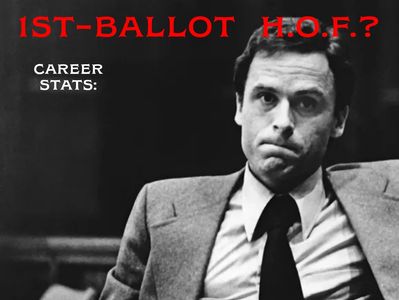
SKHOF Expected To Select Bundy in First Year of Eligibility
Serial Killer Hall of Fame Committee Deadlocked as Bundy Reaches ‘Automatic’ Threshold
By Nephew of Sam | Crime Correspondent, Quiet Loner
GARY, IN -- The Serial Killer Hall of Fame voting body—comprised largely of veteran true crime authors, documentary narrators, and one guy who hosts three different podcasts—finds itself sharply divided this week following a statistical update to Ted Bundy’s career totals.
With the confirmed identification of an additional victim, Bundy’s official number now stands at 30—widely considered the benchmark for automatic first-ballot induction.
“Historically, once you hit 30, you’re in,” said one longtime voter, speaking on condition of anonymity because, as he put it, “this is already a weird thing to have a vote on.” “It’s the 3,000 hits of… you know… this.”
Supporters point to Bundy’s consistency during his peak years in the mid-1970s, as well as what analysts describe as “multi-region production,” a rarity among his contemporaries.
“He didn’t just do it in one place,” another voter explained. “He traveled. That matters.”
Advanced metrics have also bolstered his case. Analysts cite elite deception numbers, unusually high evasion ratings, and rare dual prison escapes—often described as “once-in-a-generation athleticism” within the field.
“From a tools standpoint, he’s as complete as they come,” said one analyst. “Mobility, planning, adaptability—you’re looking at a true five-tool… operator.”
Still, not all voters are convinced.
A growing contingent of skeptics argue that Bundy’s numbers came during what they describe as a “less competitive era,” raising questions about how his performance would translate against modern investigative techniques.
“Look, I’m not saying he wasn’t good,” said one holdout voter. “I’m just saying we have to adjust for era. The game has changed.”
Others have raised concerns about “inflated legacy narratives” driven by decades of documentaries, books, and dramatizations, suggesting Bundy may have benefited from what one critic called “a very strong media market.”
Despite the debate, most insiders believe Bundy will ultimately secure induction—whether on the first ballot or after what one voter described as “a respectful, unnecessary delay to make a point.”
Voting results are expected later this year, though several members admitted they are still “trying to figure out how this became a thing in the first place.”